
 Join English Heritage


 Home


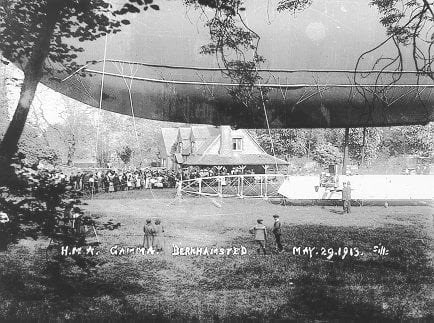

In 1913, the year before the outbreak of World War I, a large dirigible balloon was piloted over Berkhamsted and landed at Berkhamsted Castle.
Hot air balloons had existed since the 18th century, and methods of propulsion were added to balloons in the 19th century. By 1900, airships were developed as a mode of transport. As the threat of war increased in the early 20th century, the prospect of using airships as bombers was developed. H. G. Wells’s 1908 novel The War in the Air (1908) even predicted aerial warfare using military airships.
At the same time, the engine-powered, heavier-than-air aircraft were being developed, and would eventually replace airships as a mode of transport and of warfare. In the 1900s, pioneering flights of all modes evoked great interest in the public mind – this was exciting new tech.
 The Berkhamsted author Graham Greene wrote about his own childhood experiences of witnessing – or failing to witness – flight. In his autobiography, A Sort of Life (1971), Greene recalls watching the skies in vain as a six-year-old, hoping to watch a London-Manchester flight by Louis Blériot. (Blériot was famous for his historic 1909 flight across the English Channel from Calais to Dover, but Greene was only aged 4½ then. It is possible that Greene was in fact remembering Louis Paulhan’s historic London-Manchester flight in 1910, when Greene was the right age. As Greene admits, memories are just fragments.)
The arrival of an Army dirigible balloon at Berkhamsted in 1913 was a more celebrated memory for Greene, by then aged nine. The balloon was sighted over Berkhamsted rooftops, floating past St Peter’s Church, and it must have seemed like a miracle to the townsfolk. It landed for several days at the Castle, and attracted crowds of fascinated onlookers:
“Once an airship, captained by an old boy, came down in the grounds of Berkhamsted Castle and remained there for some days on show. The stationer even made picture postcards of it. It was long before I saw another airship, though I can remember being woken and wrapped in blankets and brought to a bathroom window to see a blaze in the night sky from a Zeppelin which had been shot down over Potters Bar.”
– A Sort of Life (1971)
The airship was a British Army dirigible Gamma, captained by J.N. Fletcher, an old boy of Berkhamsted School. The log of the ship’s arrival in Berkhamsted is held at the National Archives. It appears that the landing spot was not the best choice, as the crew experienced some difficulty coming down to Earth:
“Berkhampsted. A landing was effected in the castle keep, 110yds by 45 yds and is noted now as an unpractical place, and to be avoided. Suggestions. It is suggested that if it is necessary to land a ship in an enclosed place that it would be a good plan to have a light tow rope fixed to the furthest point of the nacelle.
It is necessary to come down very straight into these enclosed places and consequently all steerage way is lost. This rope would have the effect in the hands of trained men of being able to steer the ship from the ground clear of odd obstacles such as chimney pots and trees.”
[ref: AIR 1/1322/204/17/22]
